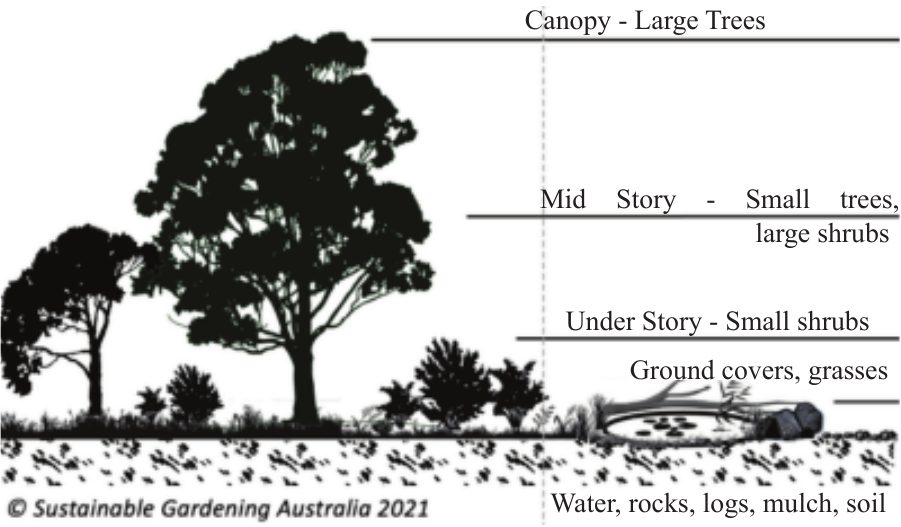
A 2025 study found vegetation complexity, not tree cover or water, is the strongest driver of bird diversity in urban parks.
Whilst conducted in an urban landscape, this study does have implications for rural areas where rural lifestyles and farming sometimes lead to extensive underscrubbing or the large scale clearing of bushland.
The study shows that the 1-3 m shrub layer is important as a refuge and food source for many species and is the most commonly missing layer in urban green spaces.
Pardalotes, silvereyes, scrubwrens, fairy-wrens, the eastern spinebill, and certain honeyeaters (eg: New Holland, Regent) are among the species affected.
But we can all help by simply adding a diversity of locally-native shrubs to our plantings.
The study recently (2025) published by Dr Nicola Sockhill and colleagues at The University of Queensland compared the complexity in vegetation with the diversity of bird species across a number of sites in Brisbane, QLD.
The authors found that bird species richness within urban greenspaces strongly increased with vegetation complexity.
That is, the more complex the vegetation, the greater the bird diversity. Interestingly, there was no significant association of bird diversity with tree cover or water cover.
While the study was based in an urban area, the results can be applied to rural properties and farms.
Clearing land to enhance views or for a perceived reduction of bushfire danger usually results with a few large trees left and the understory removed.
Many programs in Australia and globally, such as carbon credits, focus on the number of trees planted, rather than biodiversity outcomes leading to a diminished understory.
Planning vegetation coverage to preserve sufficient areas with vegetation complexity, including shrubs in the 1m to 3m middle layer, is the most important management variable to increase bird biodiversity.
A healthy and diverse vegetation coverage below 3m is also essential for native reptiles, insects, microbes and small mammals and marsupials such as blue tongue lizards and Antechinus.
The shrub layer also has a protective function, providing important shelter from aerial predators like hawks and foxes and a safe place for nests and shelters.
Visit the Birdlife Australia website for more details https://birdlife.org.au/
Ref: Level-up urban conservation by increasing vegetation complexity – Nicola J. Sockhill, Louis J. Backstrom, Richard A. Fuller
Sustainable Gardening Australia https://www.sgaonline.org.au/
Recreating the Country https://www.recreatingthecountry.com.au/