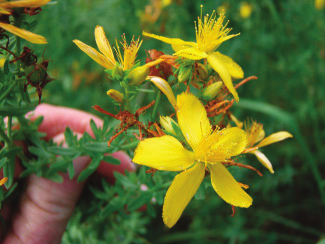
St. John’s Wort (Hypericum perforatum) is a herb with bright yellow flowers.
How does this weed affect you? It competes with pastures, poisons livestock, can downgrade wool with ‘vegetable fault’, and can reduce property value.
Livestock poisoning: St John’s wort contains a chemical called hypericin. Livestock that eat it become very sensitive to sunlight. Minor exposure affects animal health through weight loss, fewer pregnancies, stillbirths, weak young, cows producing less milk, fewer lambs and calves surviving weaning.
Intense sunlight worsens the effects. Access to shade helps protect animals. On sunny days, stock without access to shade can develop signs of acute poisoning in five hours.
Early symptoms of acute hypericin poisoning include agitation, rubbing the head against posts or trees, weak hind legs, panting, confusion, depression. As poisoning gets worse, animals get a high temperature. The skin around their forehead, eyes and ears swells and turns red. Animals can die from acute hypericin poisoning.
Control:
Pasture Management – Healthy perennial pastures are the best long-term defence.
Grazing – Make sure there are shade trees in infested paddocks. Never graze when St John’s wort is flowering.
Physical removal – Hand-weeding is not effective.
Fire – Burning can destroy seeds on the plant but it will regrow from the roots.
Biological control – Eleven biological control agents have been released in Australia. Six have established.
Search for St Johns wort at weeds.dpi.nsw.gov.au
Information from NSW DPI